
Über Mich
My path to psychotherapy began in practical psychosocial work. Since 2016, I have been supporting people in various life situations – initially in disability services and social psychiatry, and later also in acute psychiatry and homeless services.
These experiences have sharpened my awareness that psychological stress can never be viewed in isolation from a person's living environment. Relationships, housing, work, financial security, social participation, and personal learning experiences all interact. In therapy, I therefore take into account both the individual experience and the conditions under which a person lives.
I work quietly, respectfully, and transparently. It is important to me that therapeutic considerations remain comprehensible and that we coordinate our goals and approach together. In addition to understanding distressing patterns, the focus is always on making existing skills and resources visible and usable in everyday life.

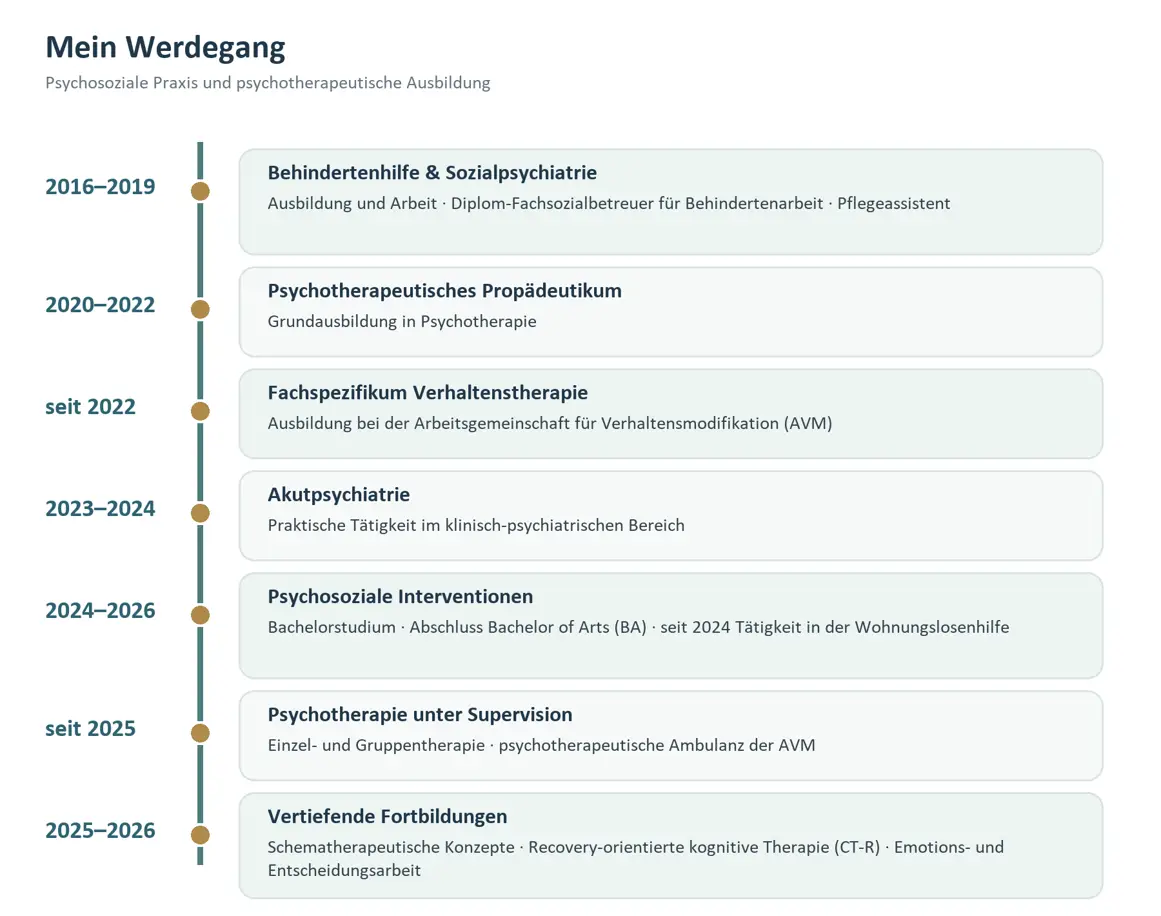
Further training and in-depth professional development
Psychotherapeutic work evolves through training, practical experience, supervision, and continuous professional development. When selecting my continuing education courses, I am particularly interested in approaches that combine a nuanced understanding of cases with concrete, practical possibilities for change.
The following areas of specialization complement my training in cognitive behavioral therapy. Which perspectives and methods are actually used in therapy always depends on your concerns, your goals, and the joint treatment plan.
- Basic Curriculum Schema Therapy
Institut für Schematherapie Wien (IST-W), 2025–2026
The basic curriculum deepens the understanding of long-standing emotional and interpersonal patterns. Schema therapy concepts can help to better classify formative learning experiences, core needs, and different internal states. In therapy, I use this perspective particularly when certain reactions or relationship patterns repeat themselves despite good intentions.
- Recovery-Oriented Cognitive Therapy
Beck Institut 2026
CT-R is a recovery-oriented development of cognitive behavioral therapy. It focuses specifically on abilities, interests, values, social connectedness, and personal future aspirations. This training supports me in developing achievable steps together with patients, strengthening self-efficacy and bringing a meaningful life back into sharper focus.
- CT-R in the context of justice and reintegration
Recovery-Oriented Cognitive Therapy for Justice-Involved Individuals, Beck Institute 2026
This training focuses on recovery-oriented cognitive therapy for individuals who have had experiences with the justice system or who face challenges of social reintegration. The emphasis is on respectful, non-stigmatizing collaboration, strengthening personal goals, and developing sustainable perspectives for daily life and social participation.
- Cognitive behavioral therapy for dealing with anger
CBT for Anger Managment, Beck Institute, 2026
This training provides behavioral therapy techniques for a more precise understanding of anger and related reactions. This includes recognizing personal triggers, thoughts, physical warning signals, and typical behavioral patterns, as well as practicing helpful strategies for emotion regulation, communication, and conflict resolution.
- Decision-making in helping professions
CBT for Helping Professionals Decision Making Skills, Beck Institut, 2026
Difficult decisions are often associated with uncertainty, conflicting needs, or anxiety about potential consequences. This training deepens participants' understanding of structured cognitive-behavioral therapy approaches, which allow for a comprehensible organization of options, assessments, values, and obstacles. This perspective can be helpful in both psychotherapy and case reflection.
- Exercise as an intervention for mental health
Exercise as a Mental Health Intervention, Beck Institut, 2026
Exercise can support psychological well-being, activation, and stress management. This training focuses on realistically and individually integrating physical activity into psychotherapeutic change processes without performance pressure. Small, achievable steps, personal preferences, and the individual's health situation are crucial.
Praxisadresse:
Stock 1